
Quantum Carbon Leap: Unraveling Structural Modifications and Breakthrough Applications of Boron-Doped Carbon Dots through Computational Approaches

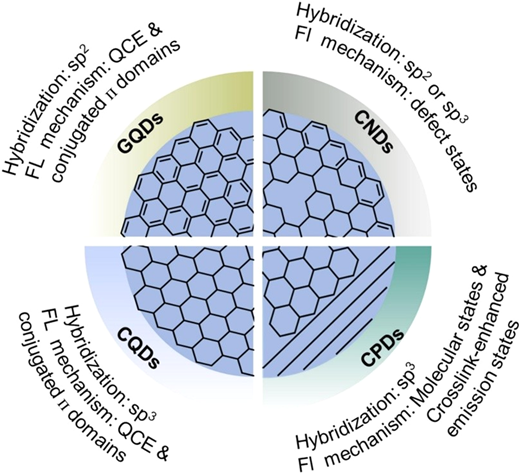
Carbon dots (CDs) are high-value zero-dimensional (0D) carbon-based nanomaterials that have attracted widespread attention in biosensing, bioimaging, anti-counterfeiting, catalysis, and optoelectronic applications such as LEDs. The key advantages of CDs include good biocompatibility, low toxicity, and high thermal and optical stability compared with metal-based quantum dots. Despite these advantages, a major limitation of pristine CDs is their relatively low quantum yield (QY) and restricted fluorescence emission wavelengths. To overcome these challenges, foreign-atom doping (heteroatom doping) is employed to effectively modify the electronic structure and surface chemical properties of CDs. Among the various available dopants, boron (B) is considered one of the most advantageous and strategic elements because its atomic radius is nearly identical to that of carbon, resulting in minimal structural distortion within the carbon lattice. As a p-type dopant with lower electronegativity than carbon, the incorporation of boron redistributes the positive charge density around the carbon framework and lowers the energy level of the lowest unoccupied molecular orbital (LUMO). This directly contributes to enhanced fluorescence intensity, quantum efficiency, photothermal stability, and a red shift in the emission spectrum. This review article provides an in-depth discussion of synthesis methods, optical properties, synergistic effects of dopant enrichment, and computational modeling approaches for the rational design of boron-doped carbon dots (B-CDs).
Content
Strategies for producing B-CDs include both single-doping and co-doping approaches with other elements, such as nitrogen (N) or silver (Ag), using hydrothermal, solvothermal, and microwave-assisted methods. Co-doping strategies, such as N,B-CDs, have demonstrated synergistic effects that significantly enhance emission quantum yields, reaching more than 44%, while also facilitating the formation of room-temperature phosphorescence (RTP) through the reduction of the energy gap between singlet and triplet states. The presence of boron also effectively suppresses non-radiative recombination pathways and facilitates catalytic charge transfer.
In addition to experimental approaches, high-precision synthesis based on vacuum gradient heating has successfully produced solid CDs with bright green emission and quantum efficiencies of up to 90%. Another crucial aspect discussed in this review is the role of computational studies, particularly Density Functional Theory (DFT) and Time-Dependent Density Functional Theory (TD-DFT), in predicting and confirming the structure–activity relationships of B-CDs. Using hybrid functionals such as B3LYP and CAM-B3LYP, computational calculations can visualize molecular orbitals (HOMO/LUMO), charge density distributions through Mulliken and Bader charge analyses, and the density of states (DOS).
The integration of experimental characterization data, such as TEM, FTIR, and XPS, into multiscale computational modeling enables a deeper understanding of boron substitution sites, surface defect states, and solvent interactions. This integration facilitates the rational design of B-CD materials for applications including heavy-metal ion sensing, such as Hg²⁺ detection, drug detection, and energy harvesting.
Conclusion
Modification of CDs through boron doping and heteroatom co-doping techniques is a highly effective strategy for improving the optical performance, quantum efficiency, and electrocatalytic activity of carbon-based nanomaterials. The synergistic effects between boron and complementary heteroatoms successfully modify the energy band gap and create unique surface states, expanding their applications from the biomedical sector to high-performance light-emitting devices.
The use of quantum computational methods such as DFT and TD-DFT has proven to be an important tool for elucidating the internal electronic mechanisms, exciton dynamics, and structural characteristics of B-CDs in depth. To fully optimize the potential of B-CD materials in the future, integrative research combining computationally driven design (in silico), molecular dynamics simulations, inverse machine-learning algorithms, and high-precision laboratory synthesis is highly needed.
Link: ACS Omega article – Advances in Boron-Doped Carbon Dots: Computational…
This article is a repost from the Scientific Popular Article page of Universitas Airlangga (UNAIR) and has been adapted for publication on the Kimia UNAIR website.
Original source: “Quantum Carbon Leap: Unraveling Structural Modifications and Breakthrough Applications of Boron-Doped Carbon Dots through Computational Approaches.”